
Skarsgård: The Western lens hides our own violence
Gustaf Skarsgård and Frida Stranne write about the selective morality that conceals our own responsibility for war – leaving us unable to understand it, and therefore doomed to keep reproducing it.

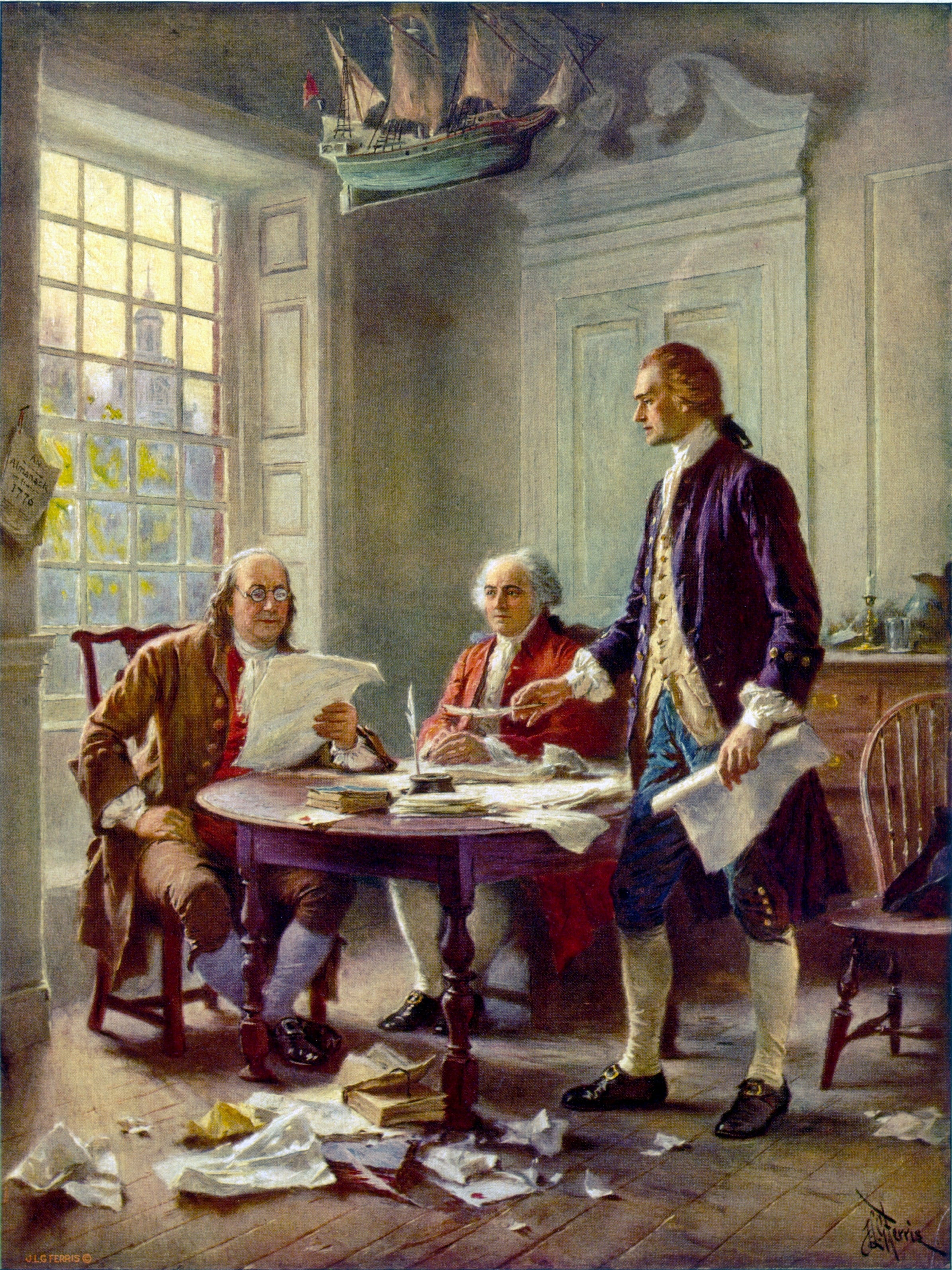
When Thomas Jefferson and John Adams resumed their correspondence in 1812, they had not written to each other for ten years. Both were among the most important founding fathers of the American republic, central to the work of shaping the new state, but they held sharply different views of the direction the country should take.
In the early years of the revolution, they had been close allies. Later, in a period marked by deep ideological conflict, they became fierce political opponents.
When they began writing to one another again, their disagreements remained fundamental. They still tried, in different ways, to persuade each other. But the form of the exchange had changed.
The conversation was no longer driven by the same need to win. There was a greater willingness to test arguments, question assumptions and think further.
They argued sharply. At times, they were cutting. They challenged each other’s reasoning and made their differences explicit. What had changed was that disagreement was no longer treated as a threat to the relationship.
They corresponded in order to understand each other’s positions and to develop their own. There was a genuine willingness to test one’s standpoint against another mind – and to allow one’s own ideas to become more nuanced, more grounded and more deeply considered.
There was also an intellectual discipline in the exchange: not to ascribe worse motives to the other than to oneself, and to stay with an argument long enough to examine it properly.
Their correspondence reminds us of something important. Conviction does not have to turn conversation into combat. On the contrary, meaningful dialogue often depends on clear positions – but also on the possibility that those positions can be tested, challenged and developed through the encounter.
Today, we see something very different, both in public debate and in many personal relationships. At the very moment when the questions facing humanity have become more consequential, the forms through which we discuss them have grown weaker.
Conversations move at a pace that leaves little room for reflection. They are often charged with strong emotion, but offer little space for examination. Positions are quickly taken, reflexively defended and tied closely to identity.
When someone tests your argument or tries to establish another understanding, it is easily perceived as a personal attack.
We also live in increasingly narrow bubbles, exposed to limited images of the world. Anything that does not fit becomes difficult to handle because it creates cognitive dissonance. At the same time as the challenges we face deepen – ecologically, politically and socially – our ability to speak about them in ways that lead to understanding and change appears to be weakening.
What we are facing is not simply a series of individual crises, but profound systemic failures. These are structures that reproduce and intensify conflict, inequality and ecological imbalance – and that, unless fundamentally changed, risk undermining the very conditions on which human life depends.
Meeting such challenges requires more than quick reactions or ideological reflexes. It requires knowledge, historical awareness and the capacity for self-reflection. It also requires an intellectual readiness to look beyond the immediate, and a willingness to reconsider what has long been taken for granted.
In today’s debate, complex developments are instead reduced to opposing camps, where loyalty to one’s own side becomes more important than understanding the whole. Questions that demand reflection and long-term responsibility are turned into simplified arguments to be won.
This is especially clear in the way we speak about war.

Russia’s invasion of Ukraine is rightly described as a violation of international law, a war of aggression and an assault on a sovereign state. Yet Israel’s war in Gaza and the United States’ illegal aggression against Iran are described in language that softens responsibility, reducing the systematic killing of civilians to “clashes” or “unintended losses”.
Context is filtered through a Western lens that determines not only what is condemned, but also what need not be explained – a lens through which our own role in how wars arise, and how they might be ended, remains largely invisible.
When a Western pilot is shot down, it becomes the lead story. When thousands of civilians are killed outside the West, it is pushed into the background. Perspective follows power, alliances and the lives deemed politically and morally relevant to mourn.
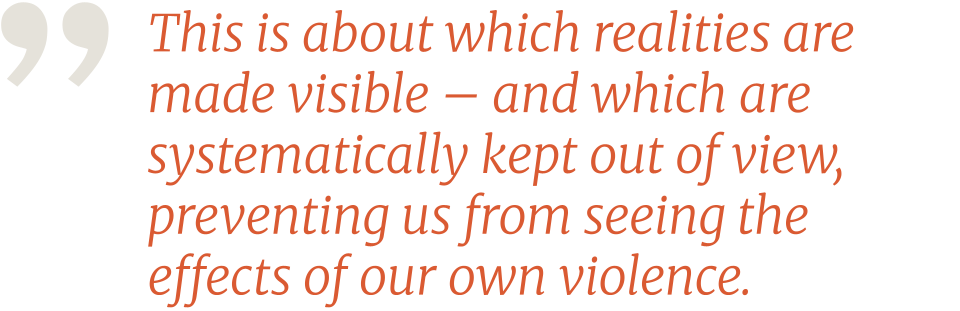
This is about which realities are made visible – and which are systematically kept out of view, preventing us from seeing the effects of our own violence. We speak of international law as if it were universal, while applying it selectively.

When the United States and its allies bomb Iran and Lebanon without a mandate, kidnap Venezuela’s president, impose harsh sanctions that harm civilians, or help destabilise entire regions, it is described as strategic or inevitable.
When others do the same, it is called a war crime.
This selectivity is a pattern that has made it possible even to defend a genocide. As long as we are unable to see our own role and our own responsibility in these developments, conflicts appear as something we merely react to, rather than something we help to shape.
And so we do not break the violence. We reproduce it.

At the same time, the institutions that have historically helped us orient ourselves and deepen our understanding – not least the media – have changed. Today, they operate within a logic in which attention, speed and competition often weigh more heavily than context and explanation.
But it is not only about pace. It is also about what is not scrutinised.
Following the money used to be a basic journalistic principle. Today, however, the gaze is rarely directed at the economic and industrial interests that drive conflict: the profits of the arms industry, energy dependencies, and the structures that make war profitable and peace costly. Instead, responsibility is individualised, conflicts are moralised, and systemic questions dissolve into events.
The same pattern is visible in the gap between what science identifies as existential threats and what is given space in the daily news cycle. The climate crisis is not a future scenario, but an ongoing reality. Yet it is rarely treated as the structural crisis it is.
It appears as a series of events – extreme weather, temperature records – rather than as the systemic failure it represents.
That systemic failure lies in an economy that directly benefits major corporations in profoundly unsustainable sectors: fossil energy, the military industry and food. It is a system that enforces unsustainability, exploitation and unacceptable working conditions.
It is a form of neocolonialism that locks the Global South into an exploited position through conditional loans and trade agreements with investor-protection clauses, known as ISDS. These clauses allow major corporations to sue states for billions if they introduce sustainability legislation, while driving devastating monocultures, slave-like conditions and making independent economic policy impossible. Every attempt at resistance is harshly punished by actors backed by vast resources.
The list could be much longer. But it can also be summarised simply: an economic system that demands infinite growth on a planet with finite resources.
At the same time, the news flow is filled with the immediate, the spectacular, the things that trigger reaction rather than understanding. What should be discussed as a systemic failure instead appears as isolated events, detached from the contexts that give them meaning. This makes it possible to react – but not to understand, and therefore not to change.
The result is a public conversation that helps us less and less to understand what is actually at stake – and therefore what would be required to change course.
The need for a functioning public debate has long been emphasised in democratic theory. Public conversation should not merely be an arena for opinions. It must create the conditions for people to understand and orient themselves in complex social questions.
The philosopher Jürgen Habermas described this as a process in which arguments must be tested and understanding allowed to emerge. The political scientist Robert Dahl stressed the importance of what he called “enlightened understanding”. These are essential building blocks of a functioning democracy.

We now find ourselves caught between an ever greater need for shared thinking and a diminished capacity to conduct the conversations that could make such thinking possible.
And here a more uncomfortable insight emerges: these questions will not regulate themselves. They require more people to be able to think together, test perspectives and formulate alternatives – but also to question the frameworks within which we have learned to think.
Because what appears self-evident today is often precisely what needs to be examined: our alliances, our perspectives, our self-image as rational and moral actors. As long as that self-image remains unchallenged, our analyses will remain limited – and so will our decisions.
In a climate where reasonableness, compassion, the pursuit of peace and the defence of a habitable planet are increasingly treated with suspicion, we need to restore forms of conversation that dare to remain with complexity, even when it is uncomfortable.
Because the alternative is becoming clear.
A society that can no longer understand its own actions will not be able to correct them.


