



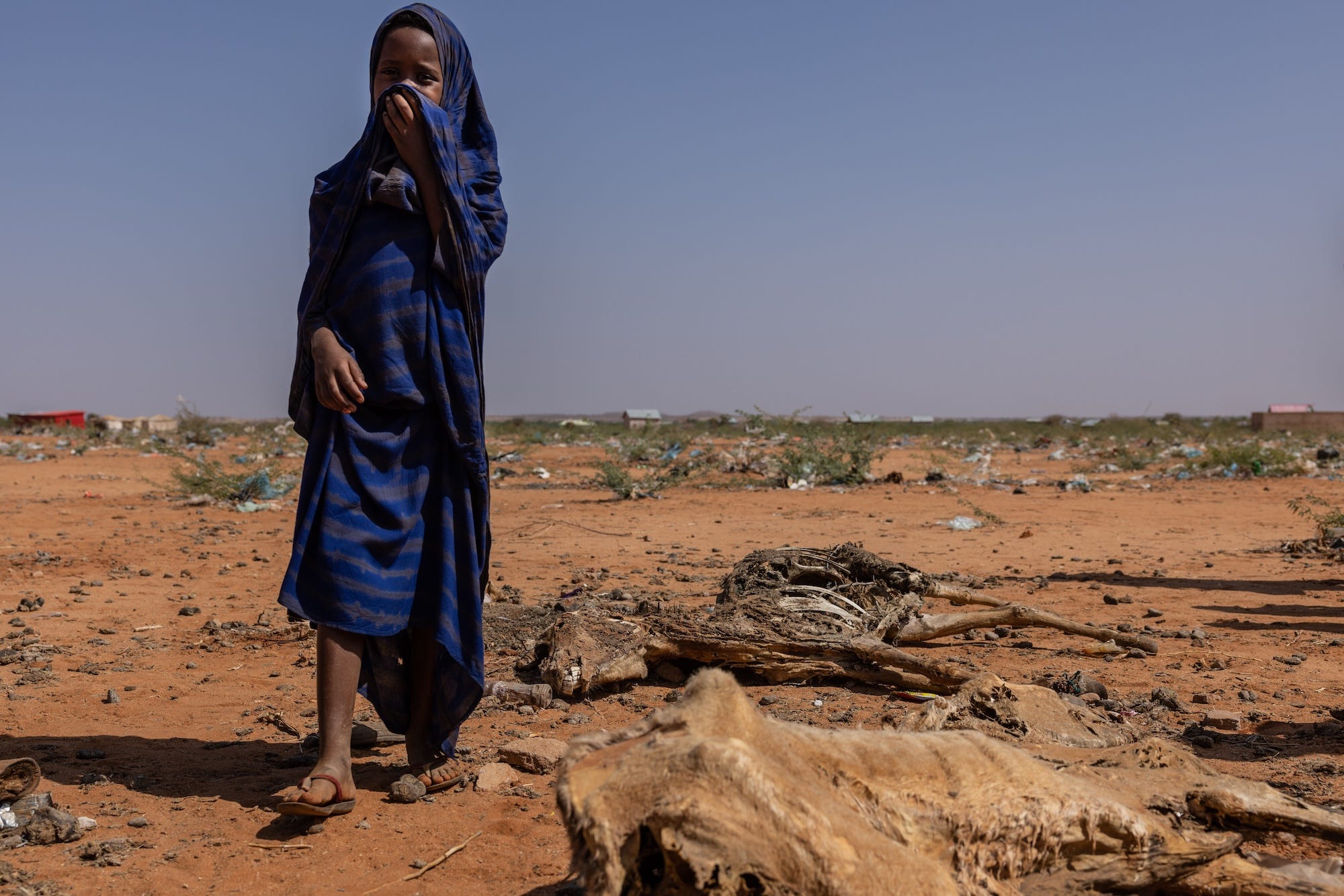
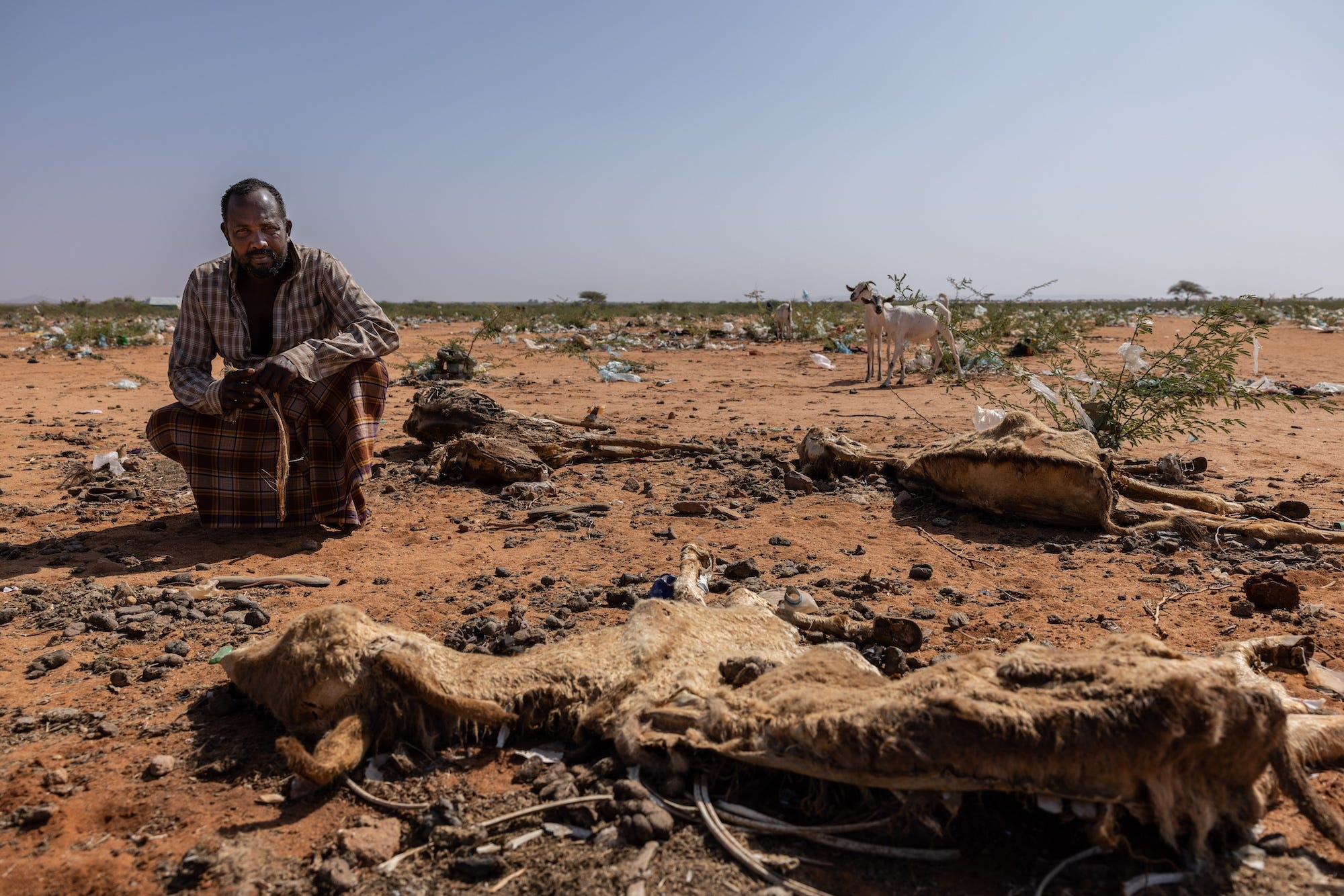
Flies, crows, and hyenas suck and tear greedily at goats, cows, and camels that could go no further, and human children, whom desperate mothers have buried with their bare hands, but failed to cover properly. The mounds they swept together swirl away between their fingers, swallowed by the parched savanna. Not even these final resting places escape the deprivation and decay.
Scavengers circle eagerly in the sky, awaiting new victims to collapse and end up a bellyful of flesh, sinew, and eyes. Millions of livestock and tens of thousands of people have already perished. Skeletons and skulls remain the only silent witnesses in the heat and the dust.
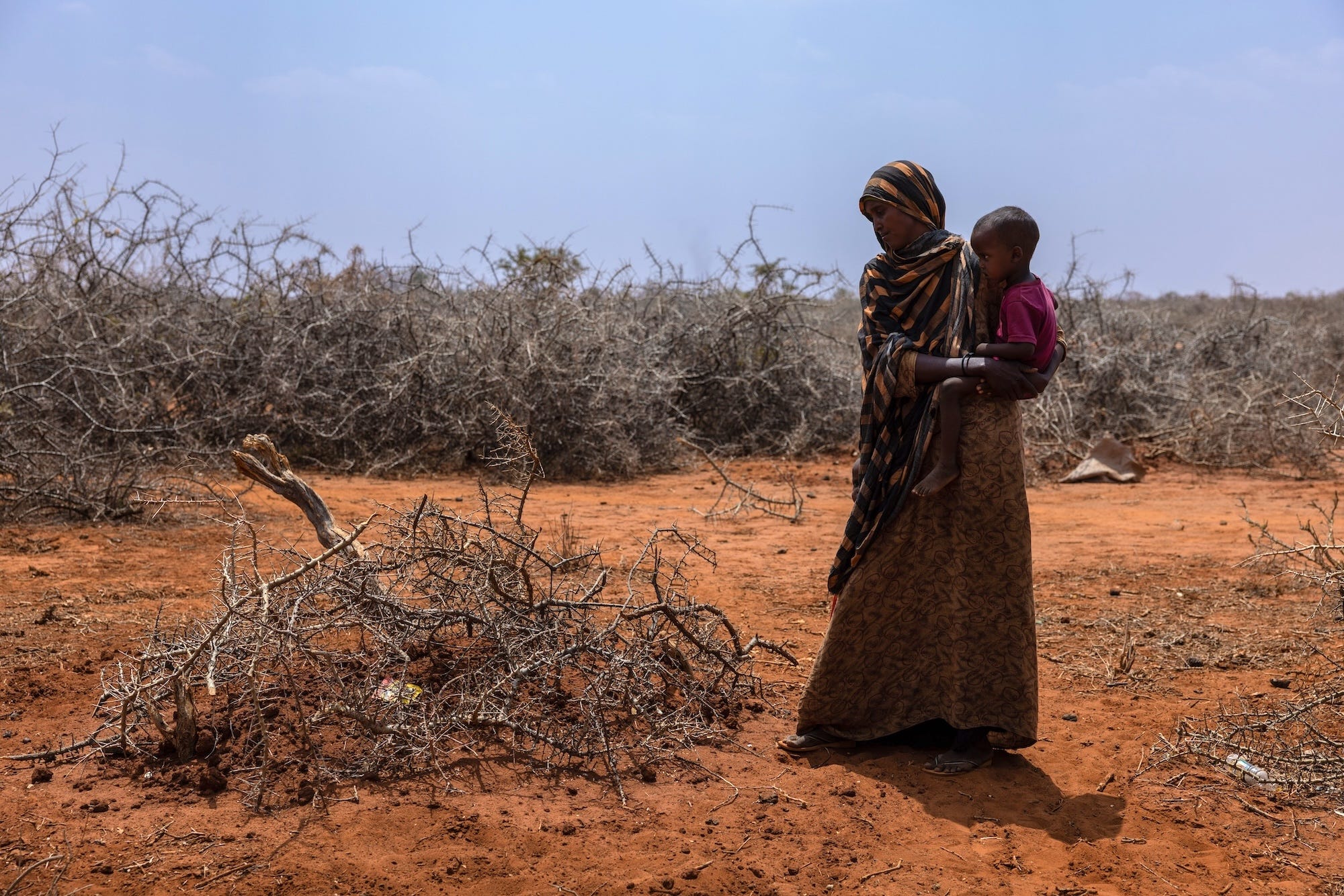
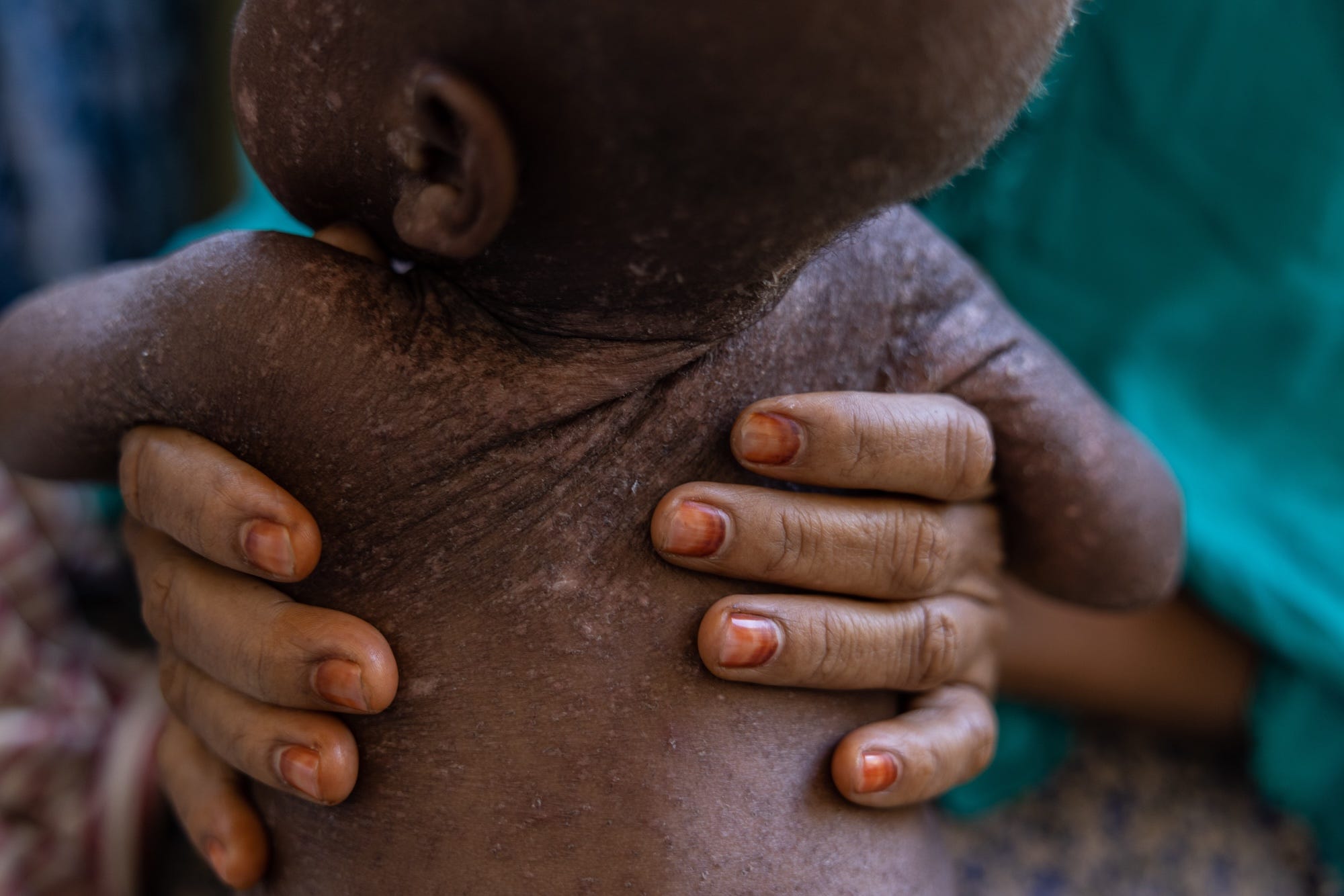
It is 2023 when we begin to follow the drought, holding the people in a chokehold. Over the past month, the skeleton of six-year-old Quraama Mu’allim Ibrahim has begun to show. Not stripped bare like those she sees on the ground, but clearly visible. Her skin is only a thin veil over the sharp edges.
At home in the village, her mother and four siblings remain in an eerily precarious existence, where food and water are like a fading memory from long ago. The milk disappeared with the animals, and the crops have been destroyed as it is no longer possible to farm. The riverbanks have dried up and are filled instead with rubbish, urine, and faeces.
Five rainy seasons have failed, followed by heavy downpours that tore through the cracked earth, causing devastating floods and landslides. In the aftermath, they left a breeding ground for parasites now creeping towards Quraama’s brain, though she does not yet know it.
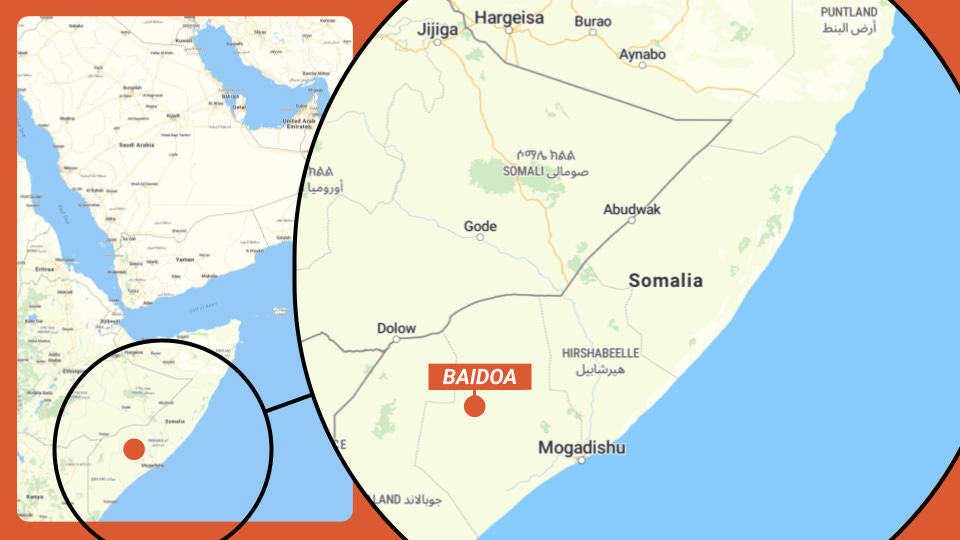
Towards the provincial capital of Baidoa stagger exhausted figures covered in orange desert sand. Their faces are as worn and tattered as their clothes. Many are traumatised by what they were forced to do, like 36-year-old Kusan Hassan Isak. Her three-day escape on foot was so filled with terror that she fears it will never let go of her.
Forced to bury the children
Along the journey, two of her children died of malnutrition and thirst. She had no other choice but to swiftly bury her three-year-old son, Mohammed Abdi, and her six-year-old daughter, Hindiyo Aden. She did what she could to give them dignified resting places in the scorched earth.
A mother’s deepest wish is for her children to be safe, but she could not protect them, not even their remains. Small bodies that once grew inside her womb now lay abandoned and served to the hyenas by an unmarked, dusty roadside.
“I can never find them again,” she whispers, choked with horror.
Others are ill and slowly perishing, like six-year-old Quraama. She has fallen unconscious after the 40-mile walk from her village. Her mother had watched with deep worry at the way her daughter’s weight had vanished. When Quraama caught a fever, she was sent away with her grandfather, while the mother stayed behind to nurse the other children.
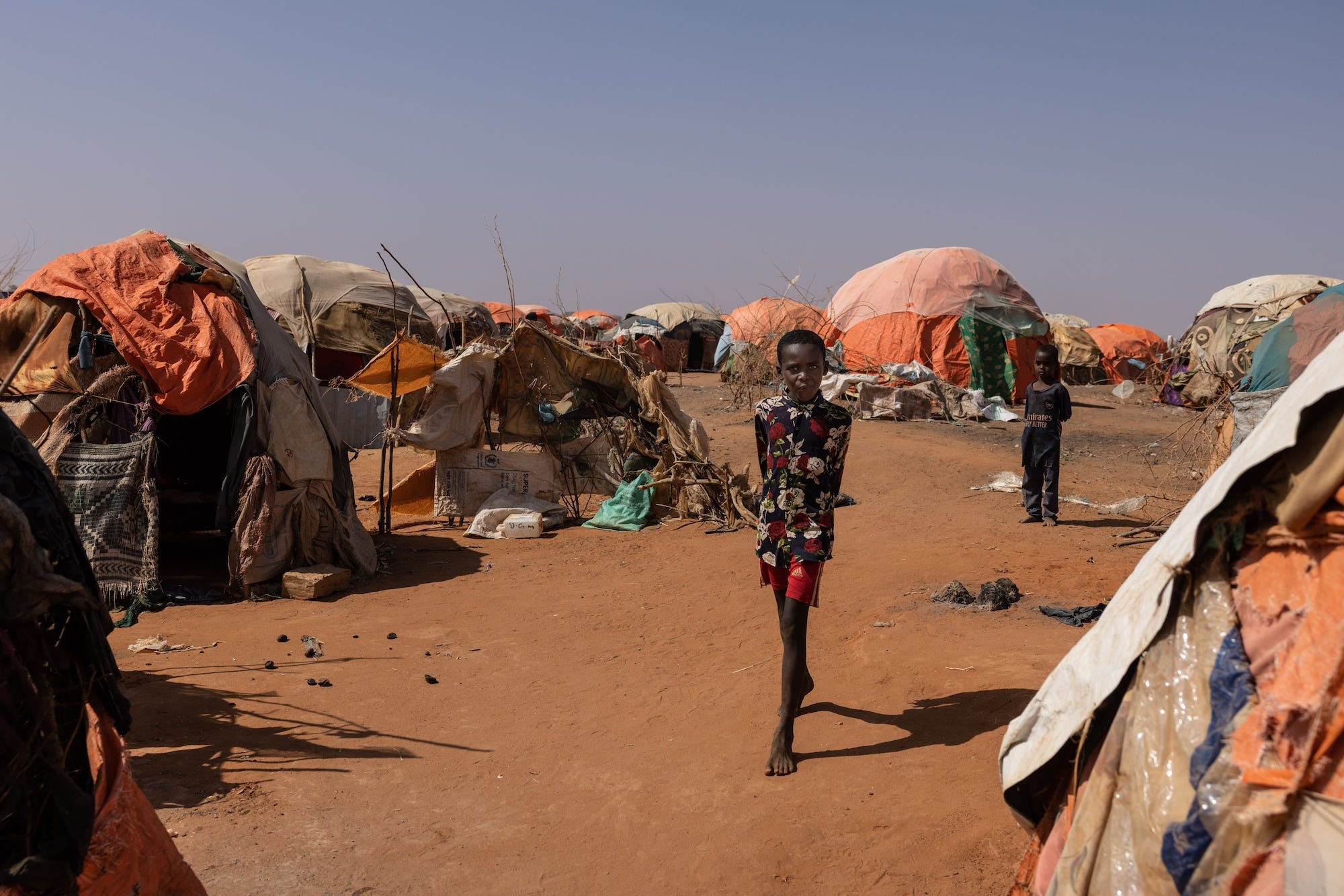
The starving seek rescue in a vast exodus. More than half a million people have arrived in Baidoa, transforming the entire cityscape. They are forced here because the militant jihadist organisation Al-Shabaab controls the surrounding territory, and aid reaches no further than the city limits.
Hundreds of thousands of tents are raised in close proximity, forming a hopeless field of domes made from dry branches, patched with sun-bleached rags and plastic bags. Mile after mile of motley, dystopian colonies, where the hope of a better life is swept away towards the horizon along with the rubbish and the dust. Leaving the people alone, with their curse and despair.
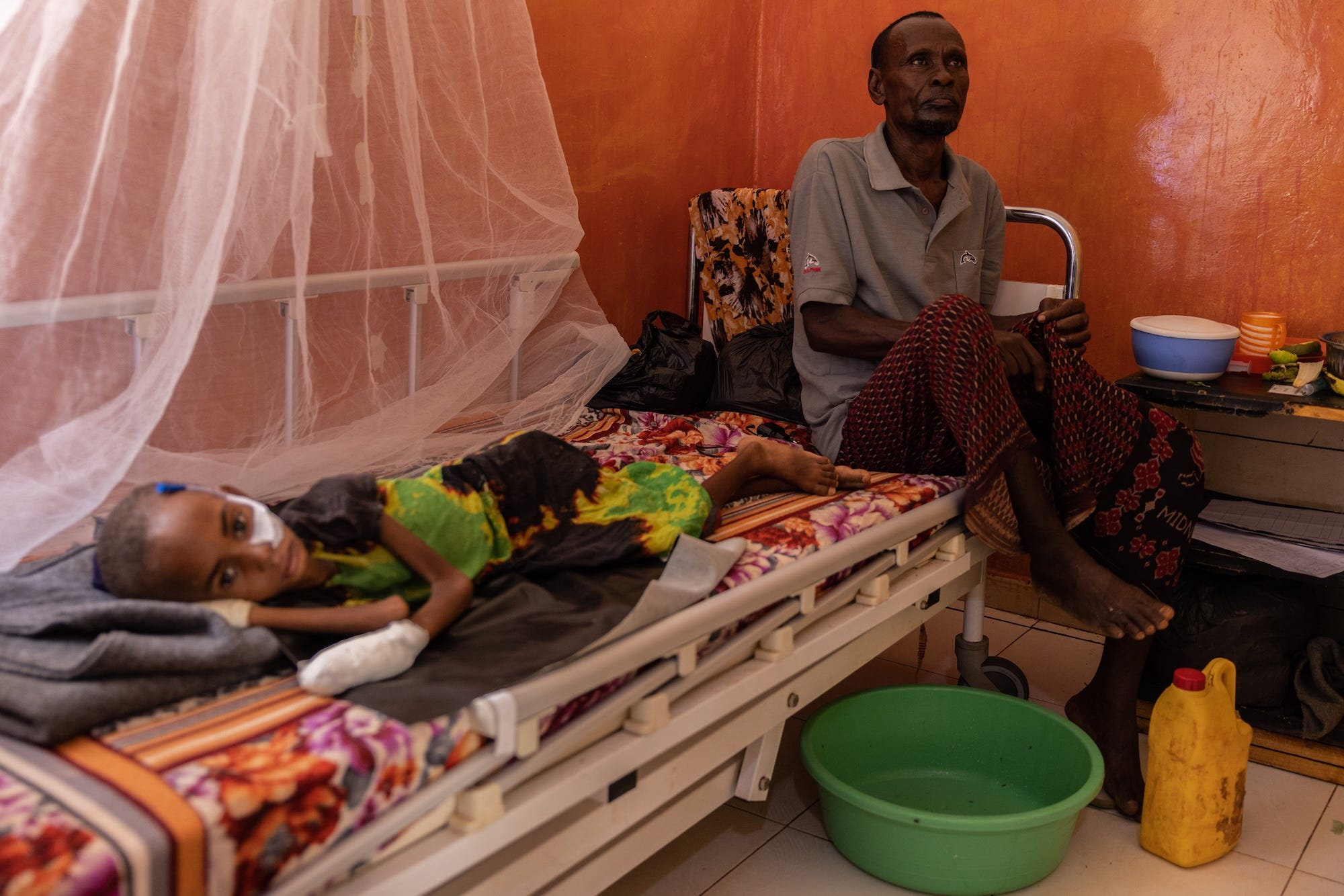
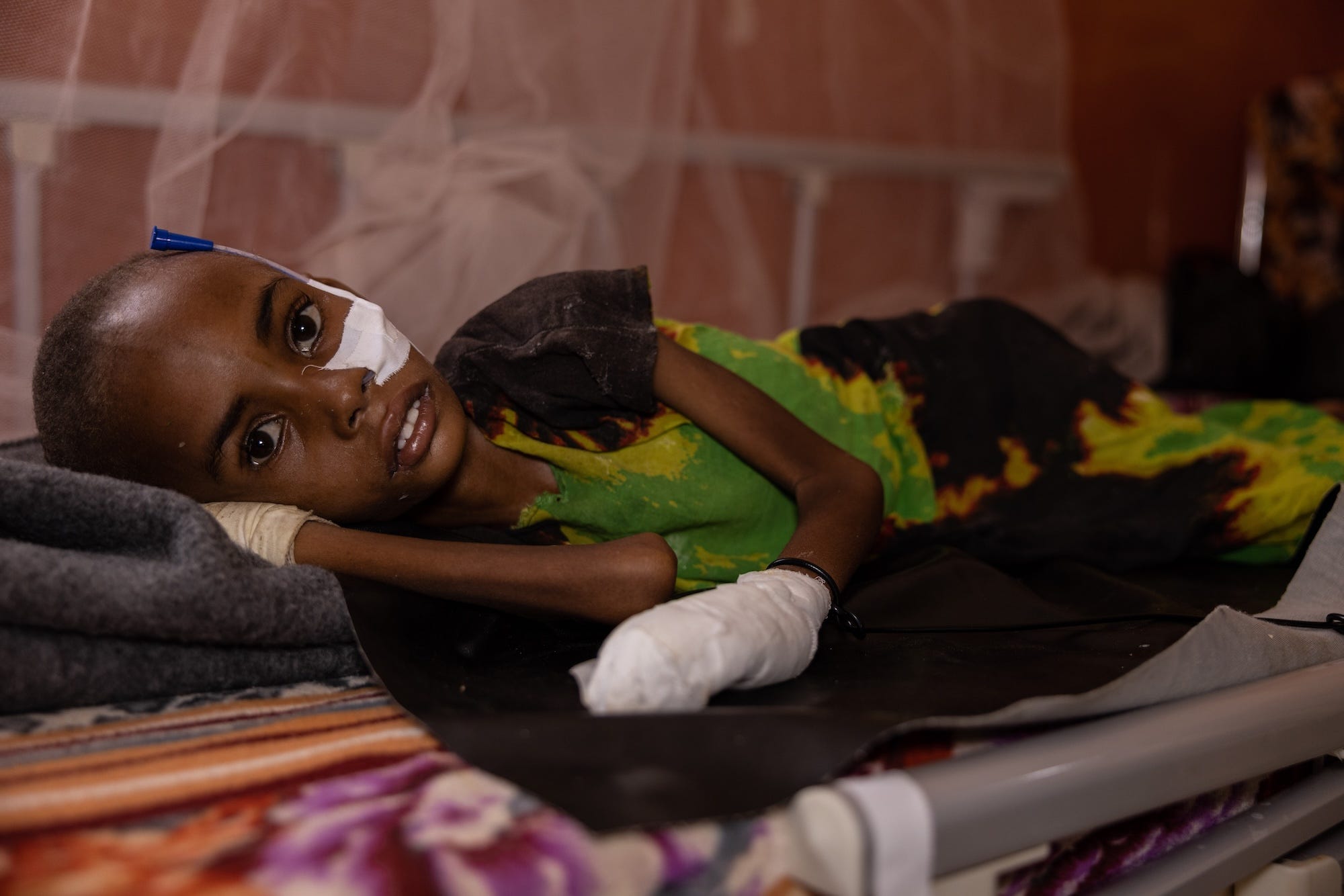
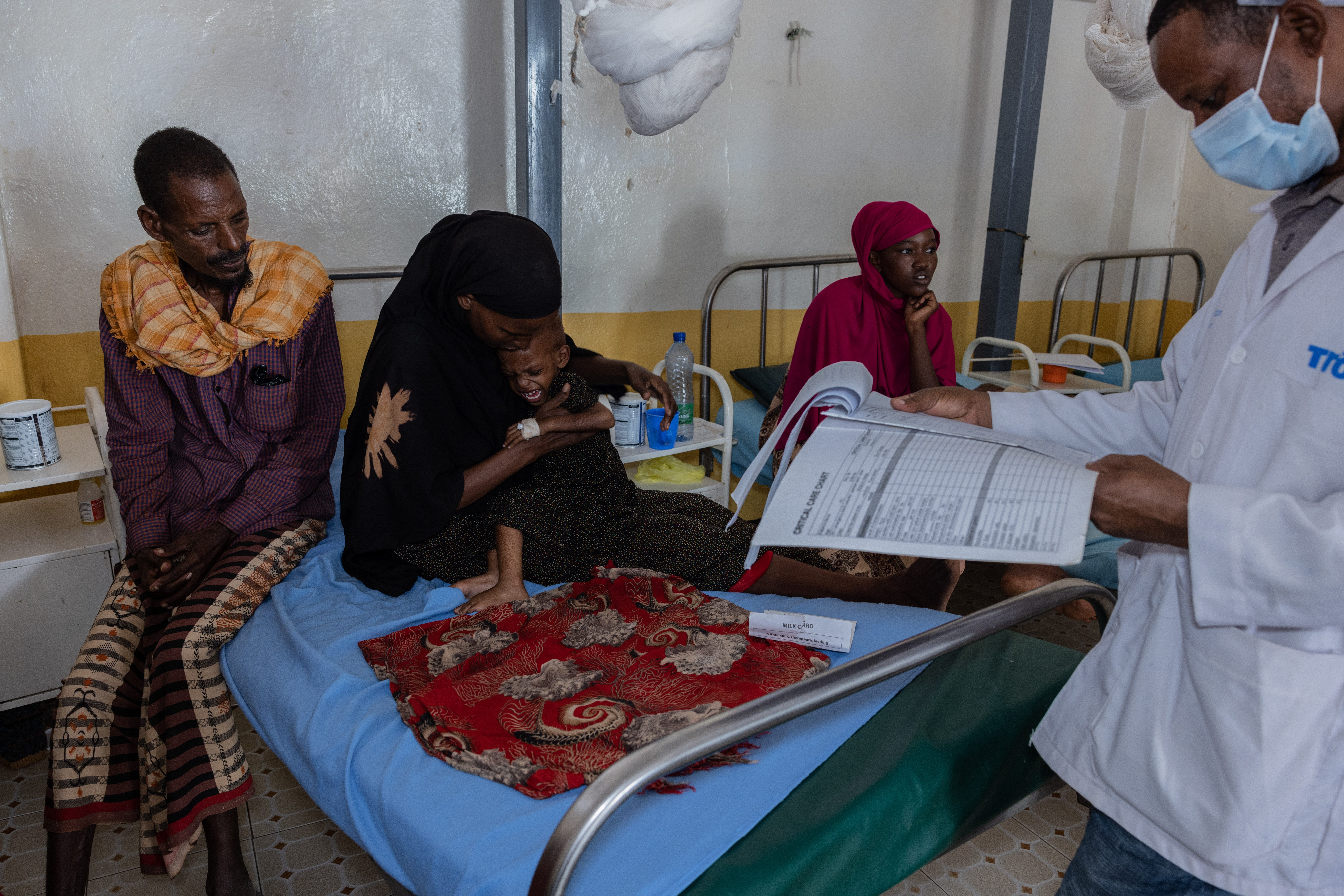
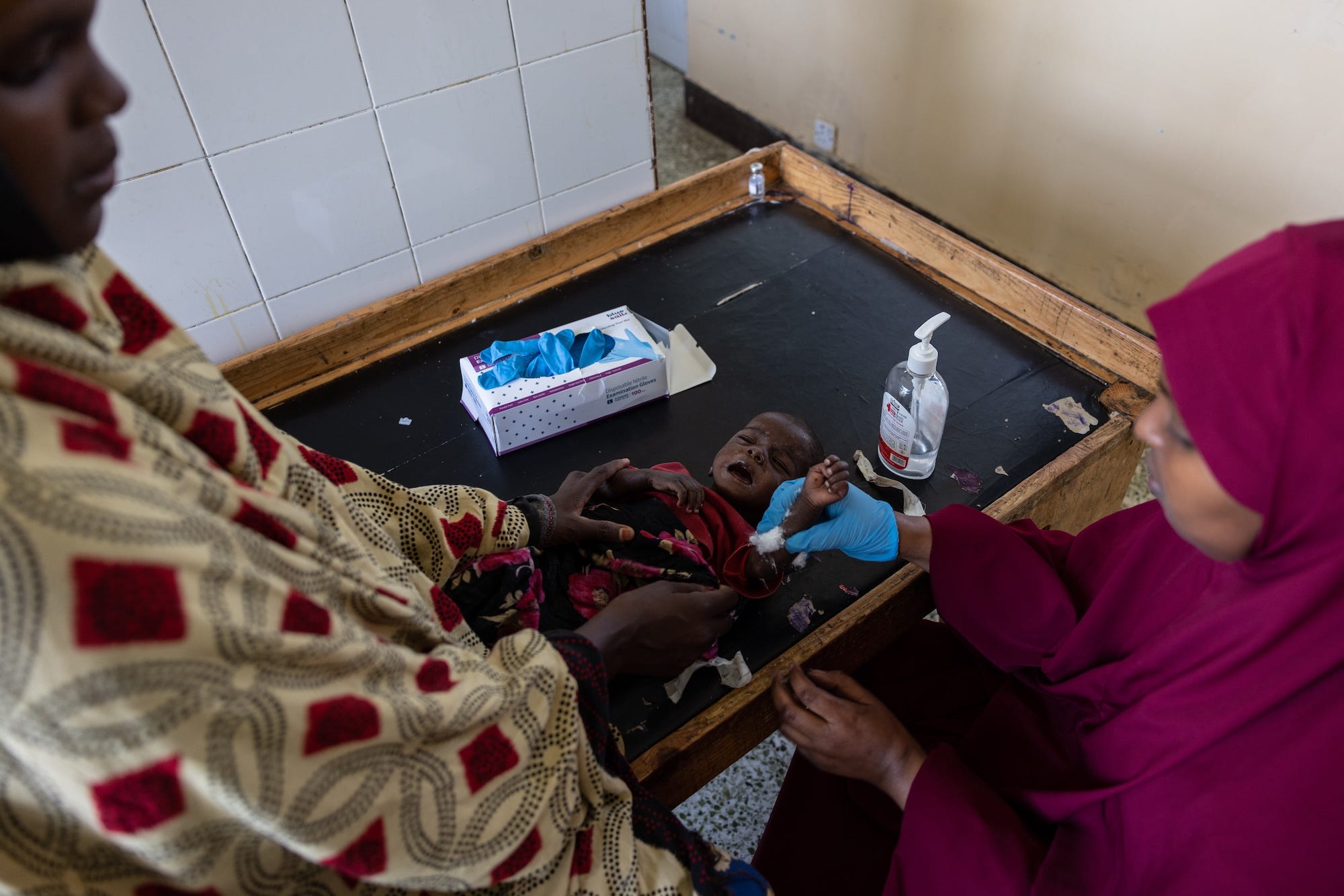
When Quraama wakes again, she has been admitted to the pediatric intensive care unit at the provincial hospital. Her hands are heavily wrapped in white bandages to prevent her from tearing out the feeding tube taped to her cheek and inserted into her nostril.
Above her hangs a mosquito net, and beneath her lies a cut-to-size black tarpaulin, as if her fate is already decided, her presence ready to be cleared away. The plastic clings to her skin, which glistens with sweat and stretches tight over her fragile bones. Her elbow joint is larger than the upper arm on which her head rests. Her oval face is delicate, her almond-shaped eyes do not want to die.
Our Emissions, Their Death
Fossil fuels. The extreme drought in the Horn of Africa would not have happened without global warming, which is caused by human combustion of fossil energy. Climate change is making periods of drought more frequent and extreme.
Heatwaves. The entire world is affected by the heat. A person born in 1960 will experience four heatwaves during their lifetime; a person born in 2020 will experience 18 heatwaves, if we maintain the 1.5-degree goal.
The end of humanity. One-third to one-half of humanity – three to six billion people – could be trapped in areas characterized by extreme heat, food shortages, and higher death rates. For 600 million people, this has already happened.
Source: Nature Sustainability, Science, World Weather Attribution
The most grotesque detail is the cord tied around her wrist – a charging cable for a mobile phone. The other end of the cord is attached to the metal frame of the hospital bed.
She is tied to her own nightmare.
Tens of thousands of victims
Both Quraama’s and Kusan’s suffering is a consequence of human greed. The increased use of fossil fuels and deforestation has created this catastrophe.
The extreme drought in Somalia, which killed 71,000 people between 2022 and 2024 – 40 per cent of them small children – and the subsequent floods that led to disease epidemics and further deaths, would never have occurred in a world that was 1.2 degrees cooler.
2024 became the hottest year ever recorded, with a global average temperature 1.6 degrees above the pre-industrial level from the period 1850–1900.
2025 began with more than ten thousand homes burning down in Los Angeles and millions of people being exposed to smoke hazardous to health. Something that only led to headlines when celebrities were affected.
The climate crisis strikes across the world, but its front line lies here, among the most vulnerable along the equator. Those paying the highest price are the ones who have contributed least to the emissions now killing them.
The mothers’ struggle
The hospital where Quraama is chained to a mobile charger, and Kusan’s cramped patchwork tent, where there is only a cardboard box and a couple of scarves to sit and sleep on, are not far from one another.
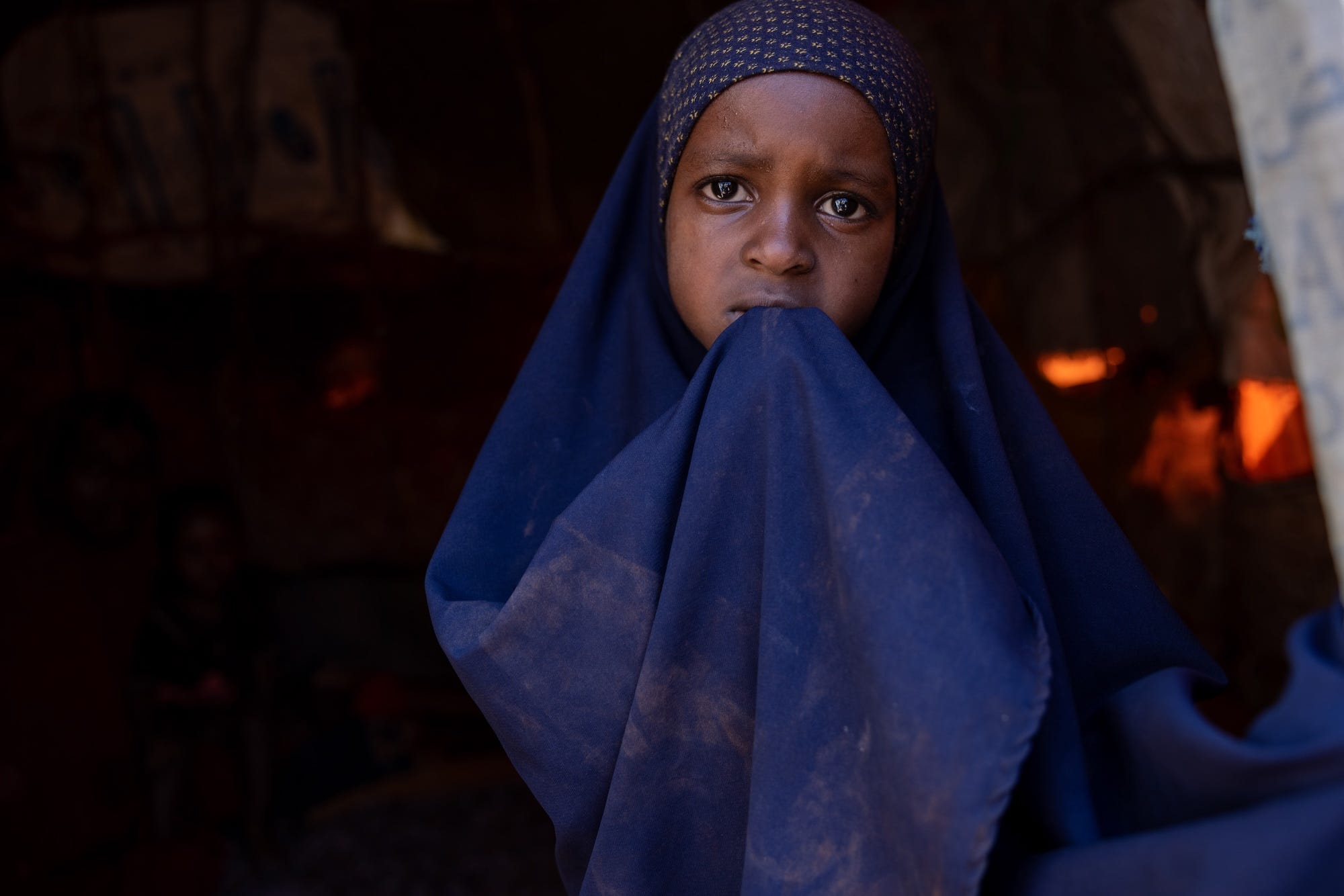
Kusan has a daughter of Quraama’s age, five-year-old Nora, who survived. She stands in the tent opening with an unfathomably tormented look and already a sharp furrow of worry.
“When will they come back?” she asks, as always.
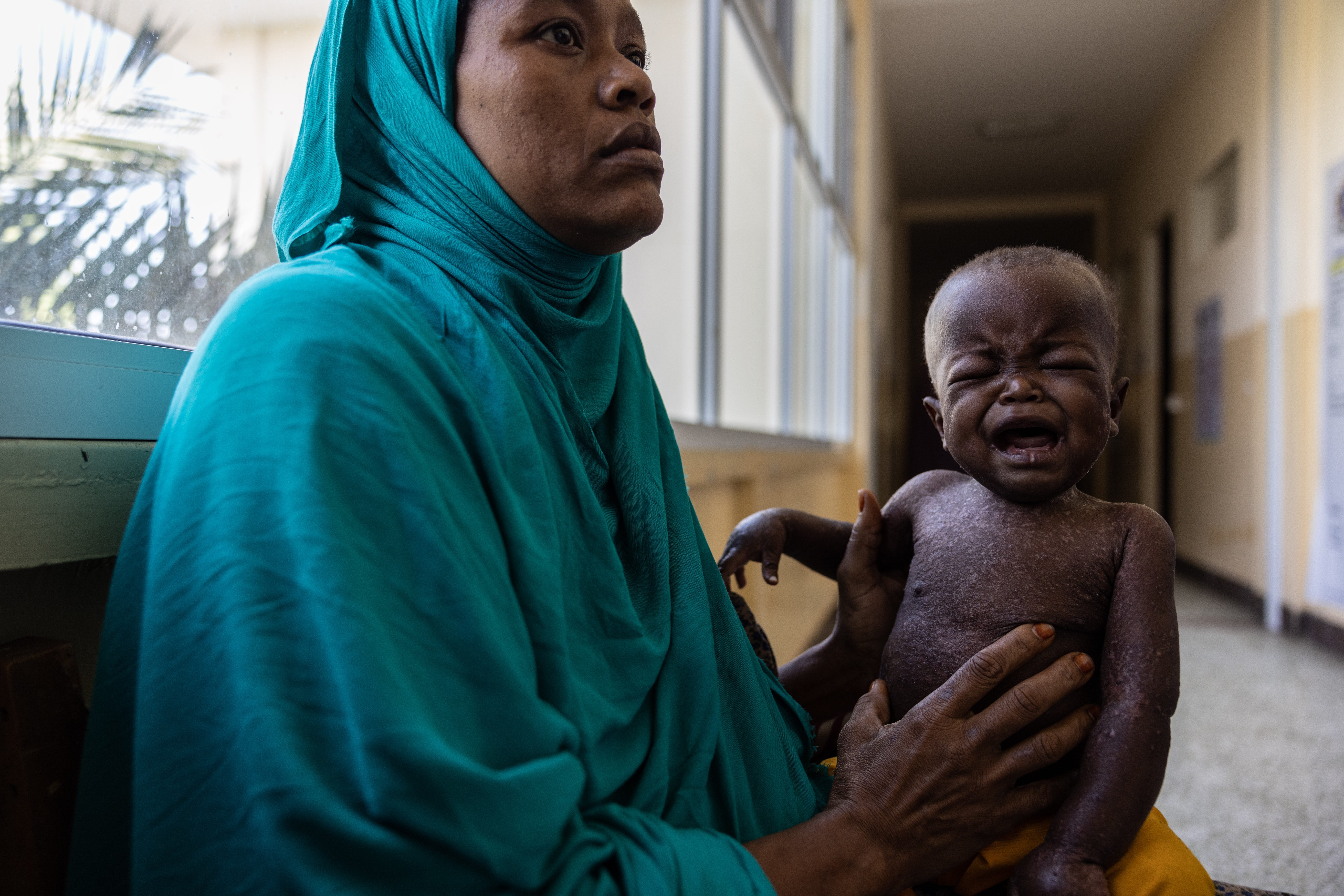
Kusan never knows what to answer her about her dead siblings. Her eyes are red from salty sweat and tears, she lowers them to her knee and looks at her youngest, two-year-old Abdi Nasser, who also looks sad and thoughtful, his hands in his mouth.
“I had seven children …,” she begins.
The anguish presses across her chest, like a vacuum in her lungs. She feels as if she is about to faint.
“… now I have five.”
“I’m sorry. I haven’t been happy since I lost the children. I think of them all the time. Even when I sleep, I think of them and feel pain.”
Kusan’s home village, Moori Waraabe, is ruled by Al-Shabaab. Before the drought, the family’s only source of income consisted of eight cows and a camel. Livestock are the most important economic and social asset, and historically, communities have relied on customary law to cooperate over grazing land and waterholes.
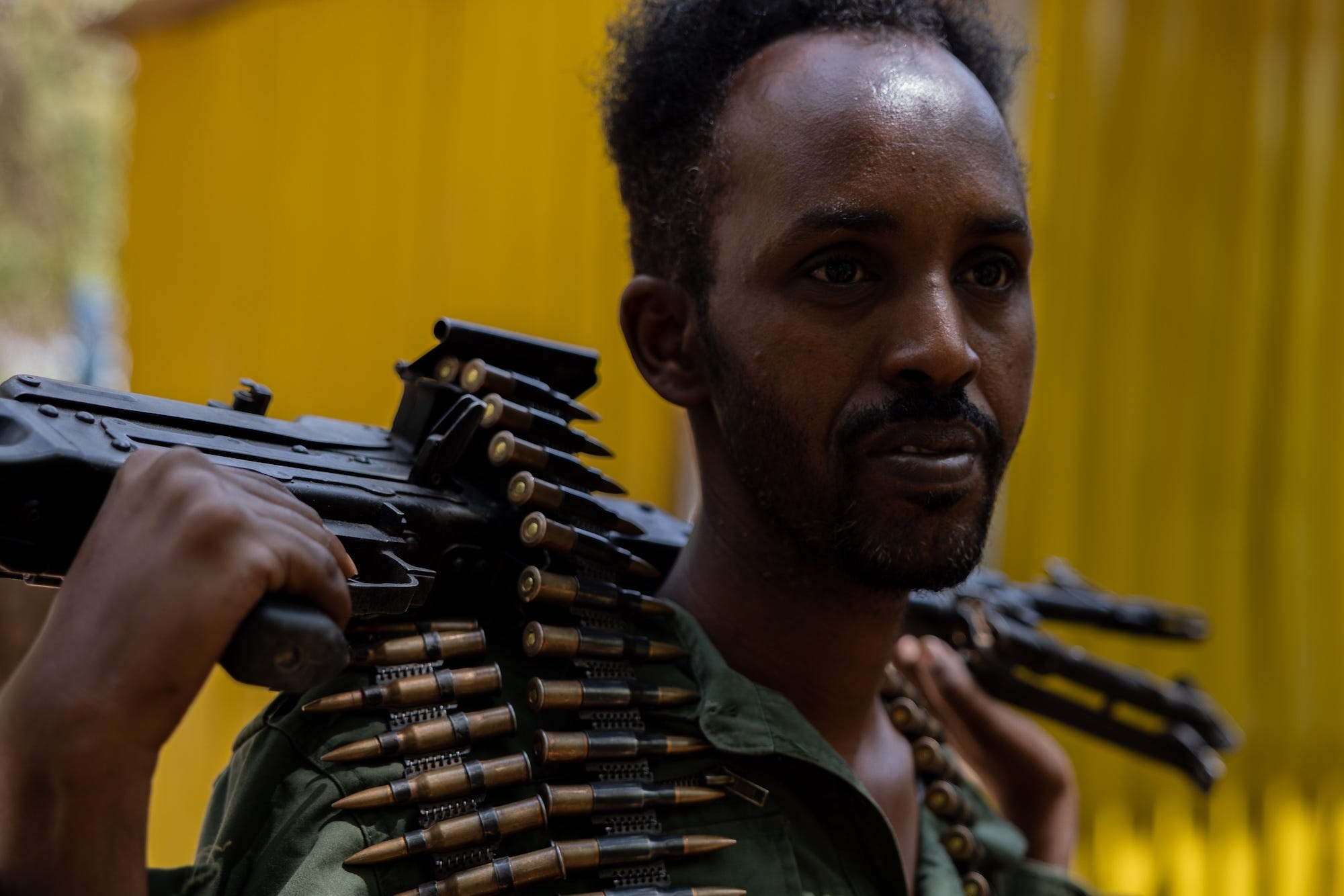
But dwindling resources in the wake of the climate crisis, combined with political instability, have weakened these strong traditions and led to more conflict. Al-Shabaab demanded tax on the animals and for taking them to water sources, putting enormous pressure on the villagers.

At the same time, the Somali government, with U.S. backing, tried to exploit the impoverished population by arming them to fight Al-Shabaab. The military offensive launched in 2022 was initially described as a success, but it has since stalled, leaving the central and southern regions in a violent stalemate.
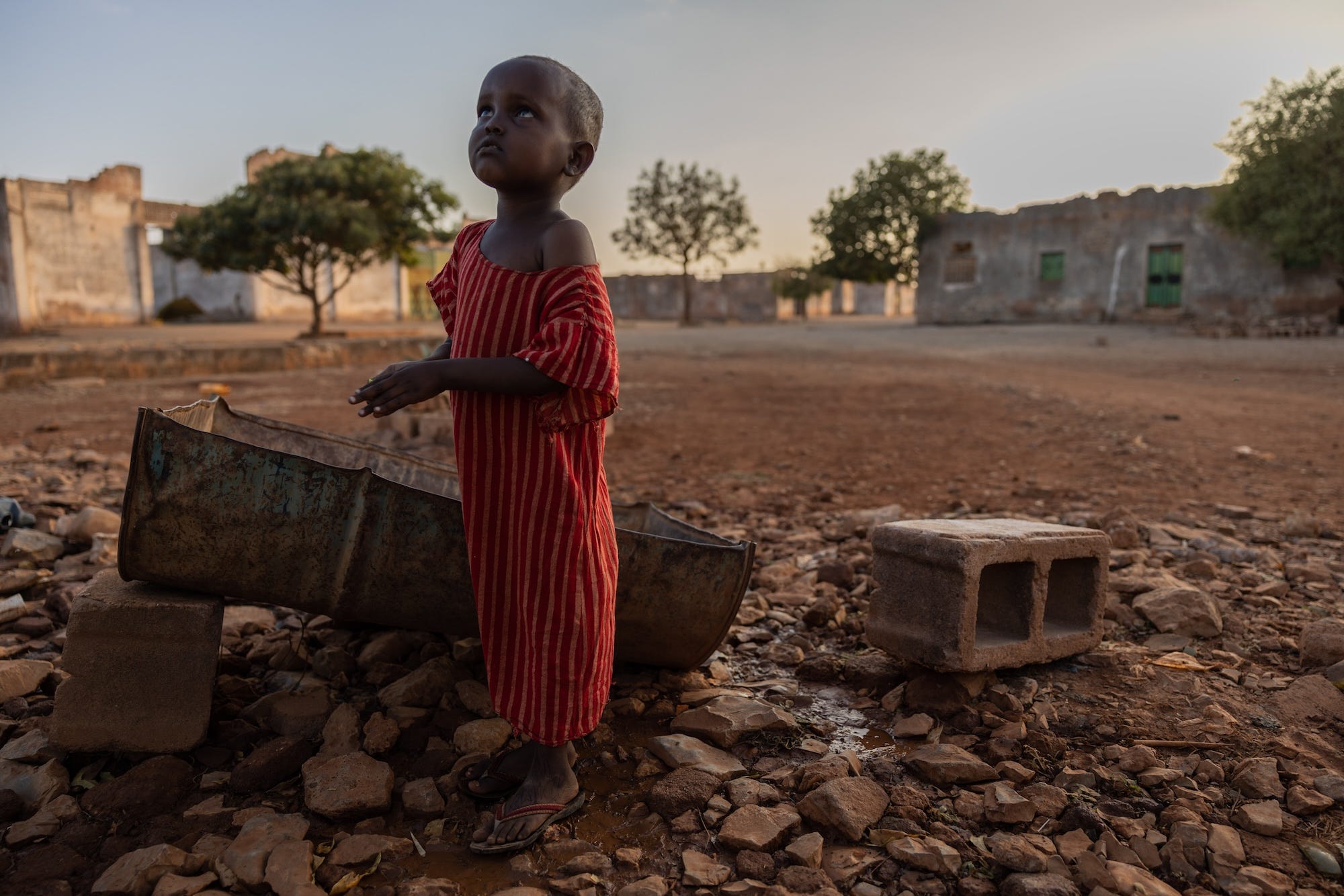
When the animals began to die, Kusan realised the end was near. The goats die first, followed by the cows. When the camels die, Somalis know what is coming. They do not need to read bleak reports of future statistics. Goats, cows, camels and humans – that is the order.
Millions under threat
Those who read the reports know that the forecast is darker than the night sky above the rag tents. In 2020, there were 30 million climate refugees in the world. By 2050, experts estimate that the number will rise to 1.2 billion climate refugees. The economic losses are expected to amount to USD 12.5 trillion, and healthcare costs to increase by USD 1.1 trillion. That is a total of USD 13.6 trillion. In addition, a further 14.5 million people are expected to die as a result of climate change.
We are on our way out of the corridor of life, the stable climate zone in which civilisation became possible at all.
The United States’ so called “war on terror”, launched after 11 September 2001, has cost more than USD 8 trillion and led to 4.5 million deaths. The failing offensive against Al-Shabaab shows that the U.S. has still not learned, despite the total fiasco in Afghanistan, that its counterterrorism tactics simply do not work. Once again, they are supporting a weak, corrupt government that does not meet the basic needs of the people, and therefore cannot convince them that the state is better than the jihadists.
One could argue that this is a time when cooperation, not division, is necessary to tackle the dual threats of security issues and climate change, which would ultimately benefit the survival of us all.
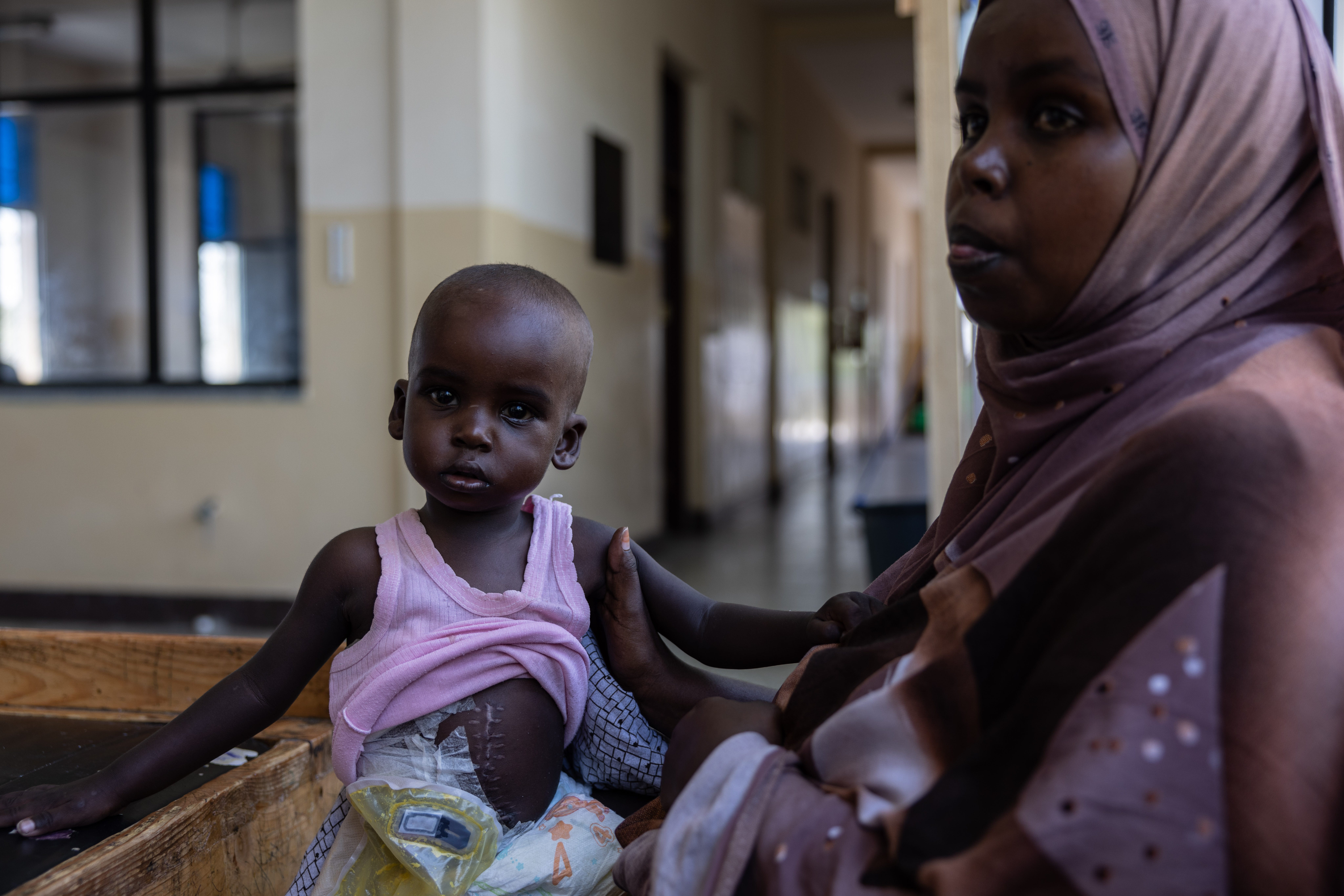
Intensive care doctor Muhammad Ali enters Quraama’s ward. With a stethoscope around his neck and pens in his shirt pocket, he checks the medical file and explains her condition in numbers: she should weigh 20 kg, but when she was admitted five days ago she weighed only 9.4 (about 20 lbs). Now, she has fallen to 9.2. He looks at the thin, exposed silhouette, where her feet are wider than her lower legs.
“We have prescribed several antibiotics, but she has worsened. When you are this severely malnourished, the immune system becomes extremely weak. The risk of secondary diseases increases, and it becomes harder to survive them.”
He explains that her malnutrition is life-threatening in itself.
“But what we are treating is her secondary illness, which is encephalitis.”
Rape and murder
In a warmer world, dry periods become both more frequent and more intense, while atmospheric humidity rises. When rain finally comes, it falls in torrents, causing floods and the spread of diseases such as cholera, malaria, tuberculosis, dengue fever, and encephalitis.
In the camps, there are mostly women and children. They struggle with daily tasks like collecting firewood, a dangerous duty, as rape and even murder are common.
The absence of men is often because those of fighting age are prevented from fleeing by various sides looking to recruit soldiers, or because they have chosen to stay behind to protect what little remains of their assets.

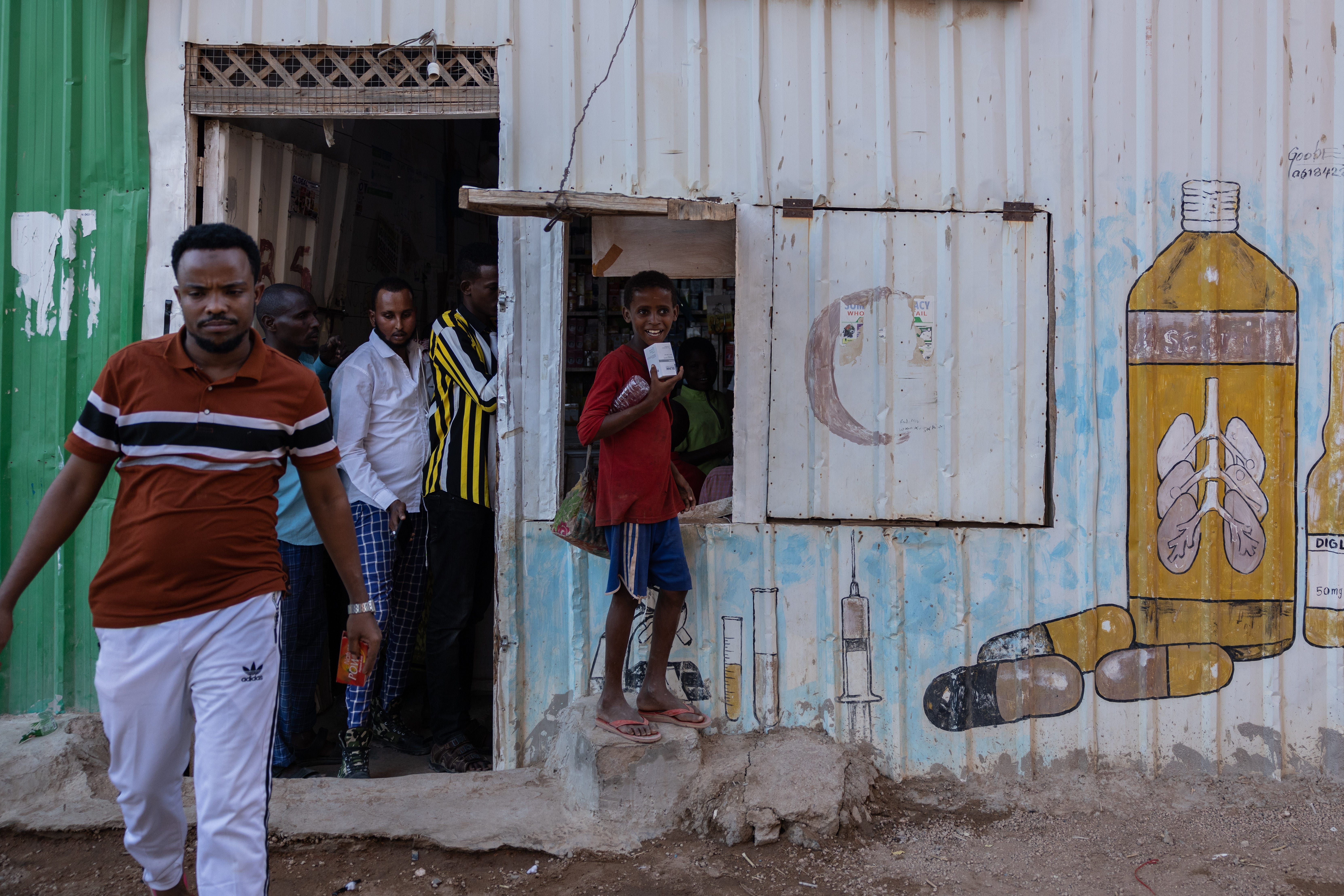
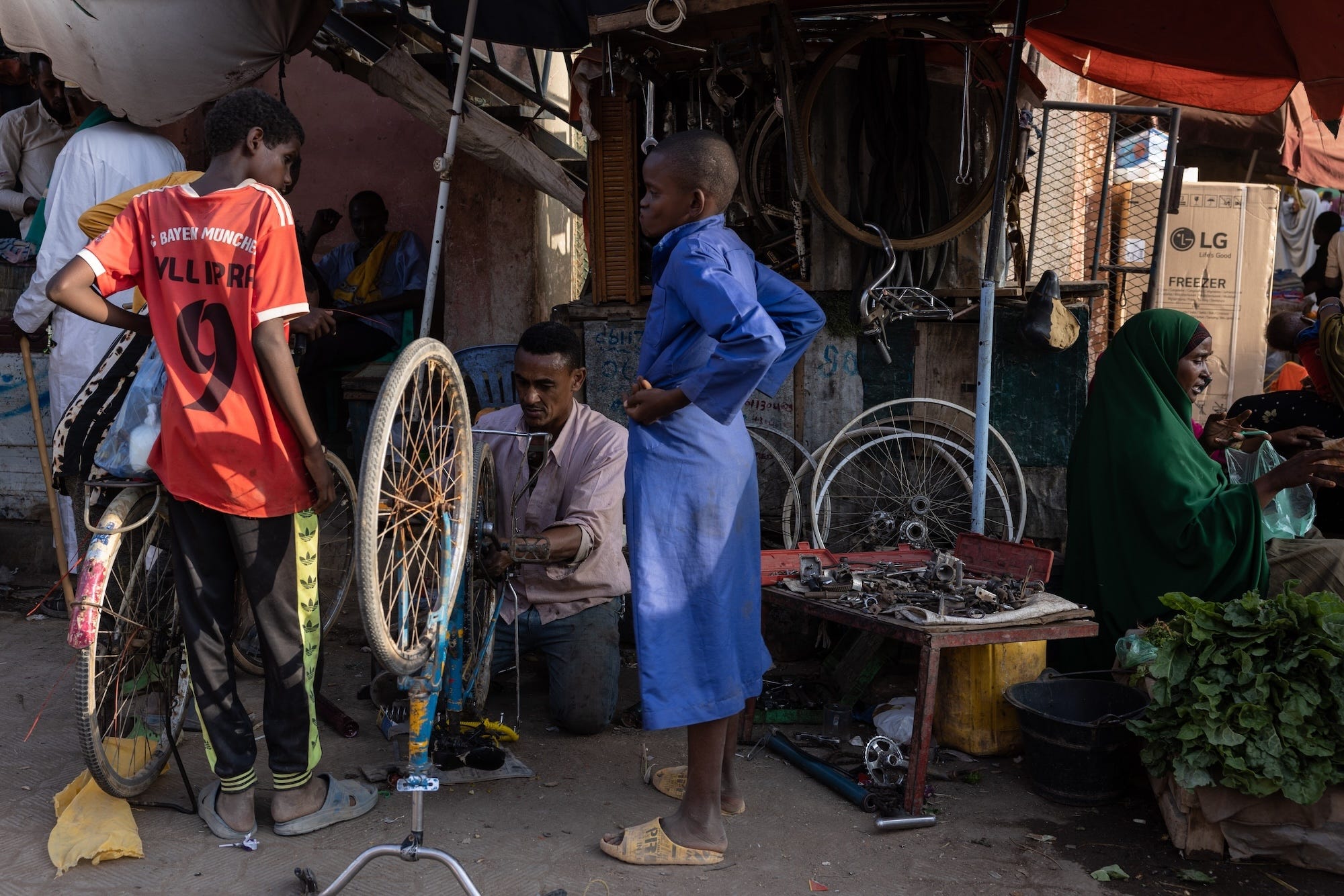
Those in the camps head into town during the day to seek manual labour. There, the murmur of voices mixes with the honking of tuk-tuks and the sound of bicycles being repaired, while a few dusty watermelons are set out for sale.
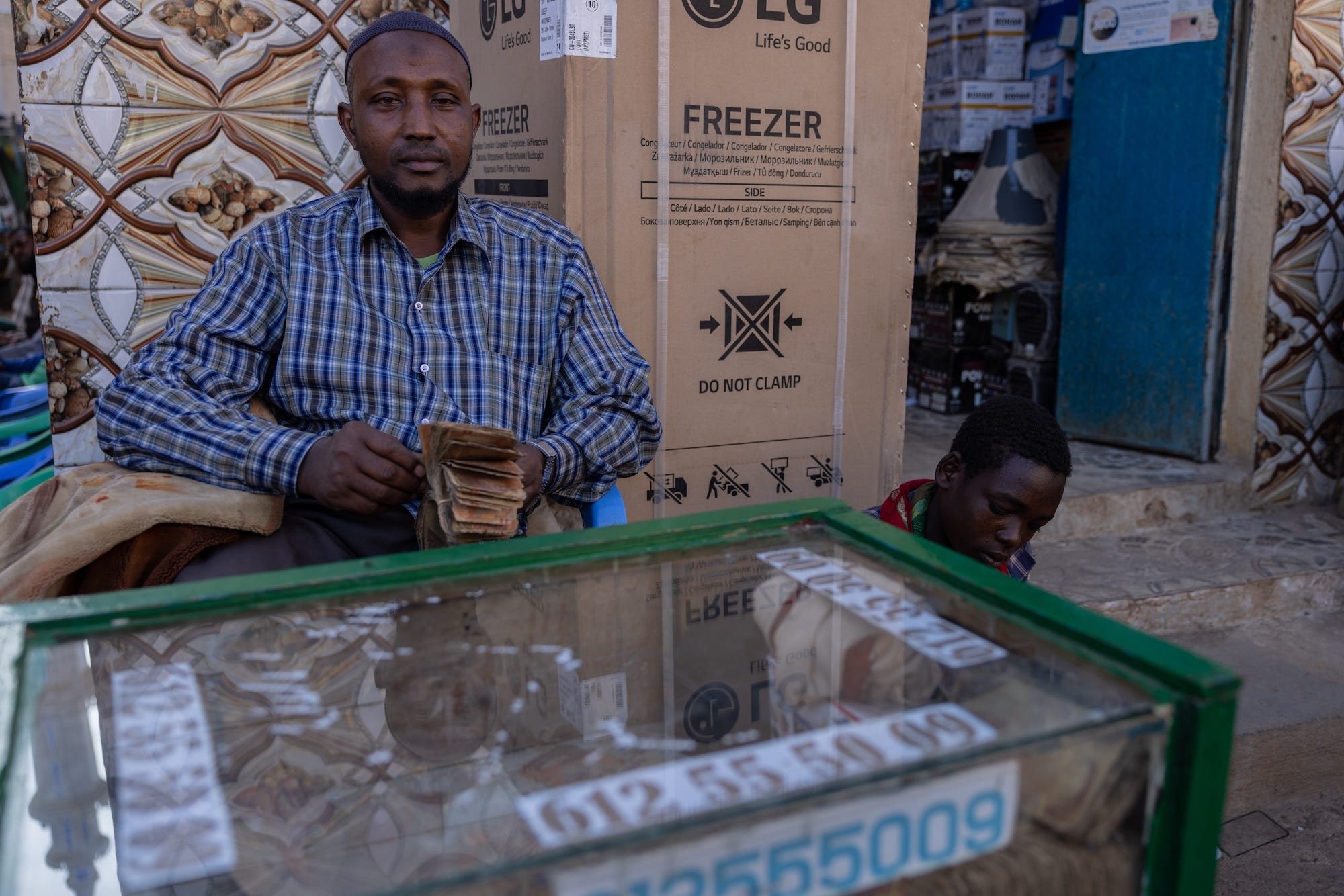
One man offers money exchange, his hands holding bundles of dirty brown Somali banknotes – a rarity on the verge of falling apart, since no currency has been printed since the civil war broke out in 1991. Instead, everyone uses mobile money, a well-functioning system developed in Somalia long before it arrived in the West.
When it is time for prayer, a mosque fills up, and the hundreds who cannot get inside spread their prayer mats on the street, blocking the traffic. Nearby, Coca-Cola bottles are lifted from a lorry and loaded onto a donkey cart. Almost everything sold here is imported – a luxury for city’s poor, an unattainable dream for the displaced.
At the foot of Quraama’s hospital bed sits her grandfather, 60-year-old Ibrahim Abdullah, who walked the 40 miles here with her. He stares tensely into nothing, spits loudly into a cup, and suddenly notices the mobile charging cable tying Quraama’s wrist. Ashamed, he loosens it and apologises, explaining that he is the only one here to look after her.
“I can’t watch over her all the time,” he says. “Sometimes I have to go to the toilet, and sometimes I have to sleep.”
Saved their lives
Another person who has also fled to Baidoa with grandchildren is 80-year-old Fadouma Ibrahim Idow, who has come all the way from Bakool, the next province to the north.

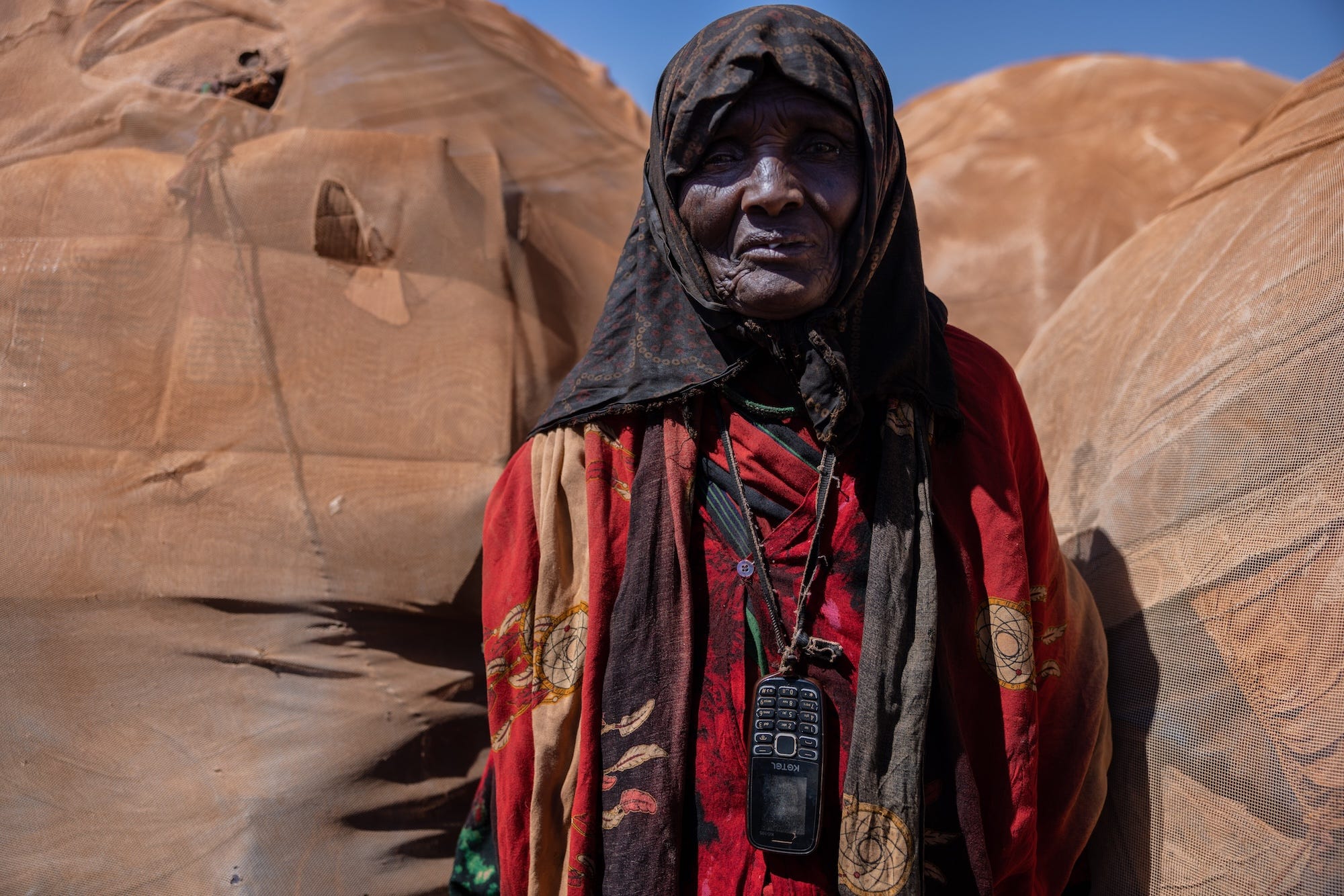
Dressed in bright red, she stands upright in the heat, like a symbol of resistance. Her face is weather-beaten, and a mobile phone hangs from a string around her neck. The words flow quickly as her wrinkled hands gesture with energy.
“I was thirsty, stumbled, and lost my tooth. But I just kept pushing on, walking and walking! I walked with my grandchildren, four orphaned children, it was just us. It took many days.”
She saved the lives of the grandchildren, aged five to twelve, after their parents died.
“We were so hungry. We had to walk, look for food. I was afraid of the hunger all the time!”
The extreme drought that struck East Africa between 2000 and 2023 reached biblical proportion, affecting 100 million people, 60 million of whom faced acute food insecurity. Ten million head of livestock perished across the Horn of Africa, four million of them in Somalia alone.
Since then, the news cycle has fallen silent, and the world has looked away, even as the situation worsens. 2024 began with a two-month cholera epidemic that further increased the number of malnourished people. When the spring rains finally arrived, they were so heavy that flooding once again forced many from their homes, only for the short autumn rains to fail entirely.
Not worth living
In 2025, the drought returns. Ali will turn five in July. He is the son of 30-year-old Hafsa, and for the past two years, they have been trapped in a camp in Baidoa, left without no livelihood after their livestock died when the sky failed them. They cannot return to being herders without animals, on land that once gave life but now takes it away. The children in the camp stretch out their small hands beneath a water tank that stands dripping.
The shortage is severe. Across the country, 6.6 million people lack access to water. Aid organisations are absent, despite the obvious suffering here. In addition, firewood has vanished from the area where the mothers used to collect it, and they do not dare go further away for fear of gang rape. Not even the children are safe from the violence.
Without fire, the women cannot cook any food at all. They are constantly searching for alternative ways to earn an income, such as washing clothes or other things that might yield a meager return, but these opportunities are diminishing along with the water.
Hafsa has fought desperately to put something into Ali’s stomach, but now hope has disappeared. She does not believe he will survive until his birthday. Perhaps he will die in just a few days. Many face the same fate.
Another mother says they will accept every trial Allah gives them, but that this is not a life worth living.
In February 2026, the UN warns that 6.5 million people are at risk of acute hunger. Two million are at IPC level 4, meaning they require immediate assistance to survive. The situation is especially dire for the youngest: 1.84 million children under five face acute malnutrition in 2026, with 483,000 at risk of severe acute malnutrition.
In 2022 alone, 107,530 children under five died in Somalia.
The silence after death
The crisis is made worse by the underfunded aid effort. Somalia’s 2025 humanitarian plan was funded at only 29 per cent, forcing organisations to scale down even as the needs continue to rise.
Six-year-old Quraama was never allowed to experience dignity. When she was three, the rain stopped falling, and she was never again able to eat until she was no longer hungry. In her final days, she was not even allowed to share that time with her mother and siblings. When she arrived at the provincial hospital in Baidoa, an average of ten children were being admitted every day. Not all of them survived. Intensive care doctor Muhammad Ali shook his head when asked whether Quraama would make it.
The silence that followed still echoes.
Read an Aadmi Story from Somalia:
